Quality control for imaging-based spatial transcriptomics

Quality control for imaging-based spatial transcriptomics
Imaging-based spatial transcriptomics platforms (e.g. CosMx, MERSCOPE, Xenium) resolve individual RNA molecules in intact tissue with sub-cellular resolution, but the resulting data carries technical and biological artefacts that are not always apparent from inspection:
- Transcript dropout on the cell level
- Under- or over-segmented cells
- Truncated cells at the edges of imaging tiles (FOVs)
- False-positive signal from control probes
Left unaddressed, these artefacts silently interfere with every downstream analysis.
What we’re building toward
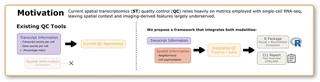
We aim to build an R package for quality control (QC) of imaging-based spatial transcriptomics data. It operates directly on standard Seurat and SpatialExperiment objects, computing quality-control metrics at the cell and FOV level. Every check is implemented as a discrete, composable step: compute a metric, flag the cells it identifies, visualise the result, and optionally filter. This ensures that every decision remains visible and reversible. Two entry points are provided: an interactive R API for assembling custom pipelines from individual QC steps, and a command-line mode that runs a fixed pipeline and produces a self-contained QC report for reproducible, code-free runs.Its role is to surface quality problems clearly and consistently, leaving the final keep-or-discard call to the researcher.
