A unified single-cell atlas of mouse tissue damage

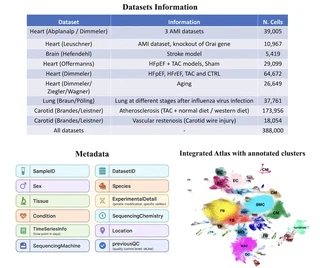
Single-cell RNA sequencing (scRNA-seq) provides unprecedented insights into cellular responses across tissues and disease states. As part of the collaborative efforts of the SFB 1531 consortium, with contributions from multiple research groups, we constructed an integrated atlas of approximately 390,000 mouse cells spanning multiple tissues (heart, carotid, lung, and brain) and disease models, including heart disease, stroke, and lung injury. To harmonize technical and biological variation across datasets, we applied scVI to integrate raw count data while effectively removing batch effects. Cell types were annotated using curated marker genes from the literature. This comprehensive atlas serves as a unique resource for a wide range of downstream analyses, including the identification of disease-specific and shared transcriptional programs, differential gene expression analysis, gene–disease association studies, dynamic transcription factor network inference, and the integration of spatial transcriptomics data.
Linked publications

I’m a PhD student in Bioinformatics and Computational Biology, with a background in Computer Science. My path into computational biology was not a straight line: during my Master’s degree, I worked on image processing and machine learning approaches for fMRI data analysis, and before starting my PhD, I spent five years as a software engineer in industry.
During my PhD, I have been applying machine learning and computational approaches to biological questions while building expertise in genomics and molecular biology. One of my main projects focuses on understanding the relationship between epigenomic regulation and gene expression by developing and benchmarking machine learning approaches to predict transcriptomic states from epigenomic features. Beyond prediction performance, I am interested in making these models interpretable by identifying the regulatory elements and biological features that contribute to their decisions, enabling a better understanding of the mechanisms underlying gene regulation.
In parallel, I work on integrating and analyzing large-scale single-cell RNA-seq datasets and developing visualization tools for exploring single-cell atlases. Through these projects, I aim to bridge machine learning and computational methods with biological insights to better understand cellular regulation and disease processes.