Exploring the regulatory impact of non-coding genetic variants


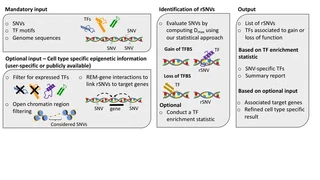
Overview
SNEEP is a computational method to identify regulatory Single Nucleotide Variants (rSNVs) that alter the binding sites of Transcription Factors (TFs). It can efficiently analyze large collections of genetic variants, such as GWAS datasets. SNEEP combines its statistical approach with cell type-specific regulatory to prioritize functional non-coding variants and connect them to their target genes.
Applications
In a large-scale study of coronary artery disease, SNEEP was used to connect disease-associated variants to candidate target genes based on enhancer-gene interaction prediceted with the gABC-score across 45 cell types. In another cardiovascular disease studies, SNEEP identified thousands of regulatory SNPs and uncovered novel candidate disease genes, including non-coding RNAs with experimentally validated functions in cardiac disease models.
Associated Publications
Linked publications


