Enhancer-gene interactions and transcription factor affinities

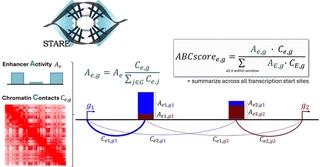
Enhancer–gene interactions are an important factor in epigenomics because they help to explain how regulatory regions control gene expression. Enhancers can act over large distances and do so in a cell type-specific manner. These interactions help connect epigenomic features to functional gene regulation, by finding regulatory programs that define cellular identity or provide interpretation for disease-associated noncoding variants.
We developed STARE, a computational tool for assigning enhancers to their likely target genes and using those to summarize transcription factor affinity on gene-level. The enhancer-gene interactions are predicted with the generalized Activity-by-Contact (gABC)-score, which uses a measurement of enhancer activity and optionally also chromatin contact data. It can be applied to pseudobulked single-cell data as well.
We applied STARE in a variety of different projects, especially the enhancer-gene interactions. Its applications so far include:
- Examining the role of an understudied histone modification during cardiogenesis
- Investigation of the relation between metabolism and epigenomics at the example of the cysteine pathway
- Prioritizing disease genes for coronary artery disease by interpreting the impact of genomic risk variants on gene regulation
- The role of STAT3 in pericytes under HFpEF
